 |
| Register | FAQ | Forum Users | Calendar | Search | Today's Posts | Mark Forums Read |


|
|
|
#1
 03-19-2009, 04:29 PM
|
|||
|
|||
 Miltonia flavescens in Snow
Many epiphytic orchids are considerably more eurythermal than most orchid hobbyists realize. For example, here's a photo of a Miltonia flavescens in Snow.
In order to help correct the popular misconception that all orchids require a greenhouse, the AOS gardens, rather than paying for the upkeep of a greenhouse, should really be leading the way in demonstrating the wide selection of orchids that are suitable for gardens in nearly frost free climates. According to this page, the AOS only has around 16 species of orchids in their garden? On a side note...it would be helpful to have two additional forum categories...a category for growing orchids outdoors and a category for growing orchids on mounts. 
|

|
#2
03-20-2009, 10:27 AM
|
||||
|
||||
|
Quote:
I checked with Nick Ewy (our Direct of Gardens and Greenhouse) and he assured me that the AOS gardens has a lot more then 16 species. The link that you referenced is the generous work of Dr Kaitz a volunteer and doesn't cover all that the AOS botanical garden maintains, it just provides a taste of what is here. I agree with you that the AOS should be leading the way in orchid education and our garden is a wonderful classroom for that.
__________________
Brian Swanson
|


|
#3
03-20-2009, 03:01 PM
|
||||
|
||||
|
I read your thoughtful suggestion this morning but have not had opportunity to reply until now. First I would like to comment on the Miltonia photo...I would bet that when spring rolled around, the poor plant was leafless and probably did not survive. Cold damage may not show up until days, weeks or even months after the event. Here in South Florida, "fall" is usually in February-March when the trees drop leaves after a cold winter.
I think that by default, the AOS garden is demonstrating what plants will tolerate lower temperatures. I know that the garden staff would take measures to protect plants if a freeze or frost were predicted. In the past, sensitive plants have been covered, or water has been run early in the morning. I don't have to tell you that plants grown "hard" on a tree with bright light and abundant air movement are far more resilient to temperature extremes than greenhouse-grown plants. Here in West Palm Beach we had a Den. anosmum growing on a mango tree at my last house. Being deciduous, we discovered that it could easily withstand sub-freezing temperatures after it survived the freeze of 1989 when we had three nights with temps below 30F. I was at AOS yesterday and the plants did not look bad after a winter that saw many nights in the 40's and a few in the mid-30's. What I am saying is that the data is there, it is just a matter of someone documenting it. This might be a good project for a plant science student at one of the local colleges. I don't know that Florida would be as good of a location as Southern California. Our winters are too inconsistent. I have lived here for almost 40 years and I can tell you that if you come to our house for Christmas dinner, you may be wearing shorts or a heavy sweater. It probably won't be raining though! We can have a whole winter that sees only a few nights in the 40's, or a winter with a week's worth of frost. Nonetheless,your suggestion deserves consideration and I will bring it to the attention of the Research Committee chairperson. As for your side note, I think we will wait and see what other suggestions users make before we slice and dice it. Greg Allikas Chair, AOS Publications Committee
|

|
#4
03-21-2009, 09:08 PM
|
|||
|
|||
|
bswanson, thanks for the welcome. I'm glad to hear that there are more than 16 species growing in the gardens year around. Providing a complete documentation of the species would be very helpful for gardeners in nearly frost free climates.
Graphicgreg, according to the description of the Miltonia flavescens photo...the orchid did not sustain any damage from the snow. On another forum a member wrote..."oncidium bifolium y Miltonia flavescens, se aguantaron una nevada leve, y hasta 40Cº"...translated...Oncidium bifolium and Miltonia flavescens can withstand from a light snow to 104F. Although, not sure if they are basing their information on the same photo. While at the Santa Barbara show yesterday I came pretty close to purchasing a nice blooming sized Dendrobium anosmum for $12. Just recently, on some of the other forums a couple people from the Philippines had posted photos of spectacular D. anosmums blooming in trees. I've been on the lookout for another pendent orchid for my Cedar Tree, but I didn't purchase it because I've never run across any documentation of D. anosmum surviving even mildly cool temperatures. As bswanson said, the AOS gardens are a wonderful classroom. Given that the large majority of orchid hobbyists are not able to attend the classes in person... documentation is really quite essential if the lessons are to be shared. Documenting minimum and maximum temperatures tolerated by the orchid species in the garden is really quite simple to do. In terms of how suitable Florida is as a location compared to California...well...personally I think Florida summers more than make up for Florida winters. But just in terms of temperature...the less suitable a location is...the greater the quantity of people who will benefit from the discovery of an orchid that will tolerate that temperature range. For example, I have a friend in Rome, Italy who experiments with growing orchids outdoors. Just in terms of temperature tolerance...any orchids that work for him will also work for me...and anybody else with a smaller temperature range. 41.95N | 79 ft | Rome, Italy --- 34.05N | 256 ft | Los Angeles, CA 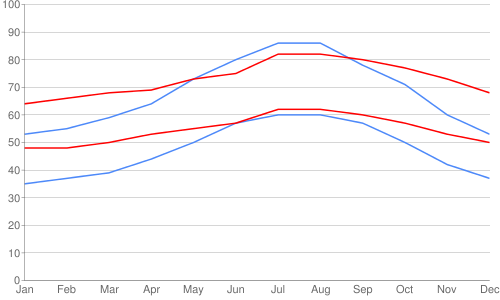 Sources: Orchid Culture, Weather Reports,Temperature Charts Given that the AOS has greater resources...in terms of land and orchids...it's my hope that the AOS will lead the way experimenting with growing a larger selection of orchids in the garden. Doing so will increase the quantity of orchid hobbyists who will be able to derive some benefit from the gardens...and provide them with additional incentive to financially support the gardens. In the meantime...if anybody has any extra epiphytic orchid species...feel free to send them to my friend in Italy to help support his experiments. 
|
|
#5
03-24-2009, 05:59 PM
|
|||
|
|||
|
Just ran across an orchid grower in Ireland who is experimenting growing Dendrobium nobile and Dendrobium kingianum outdoors year around.
53.41N | 279 ft | Dublin, Ireland --- 26.66N | 20 ft | Delray Beach, FL
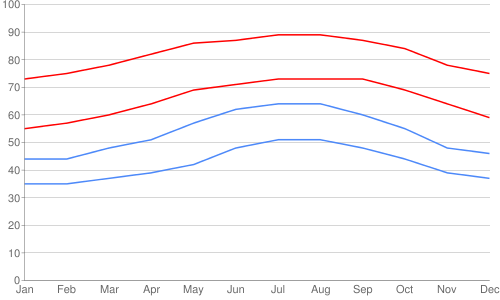 Sources: Orchid Culture, Weather Reports,Temperature Charts
|
 |
| Bookmarks |


| Tags |
| eurythermal, landscape, miltonia, mounted, snow |

«
Previous Thread
|
Next Thread
»
| Thread Tools | |
| Display Modes | |


 Hybrid Mode
|
|

All times are GMT -4. The time now is 10:25 AM.